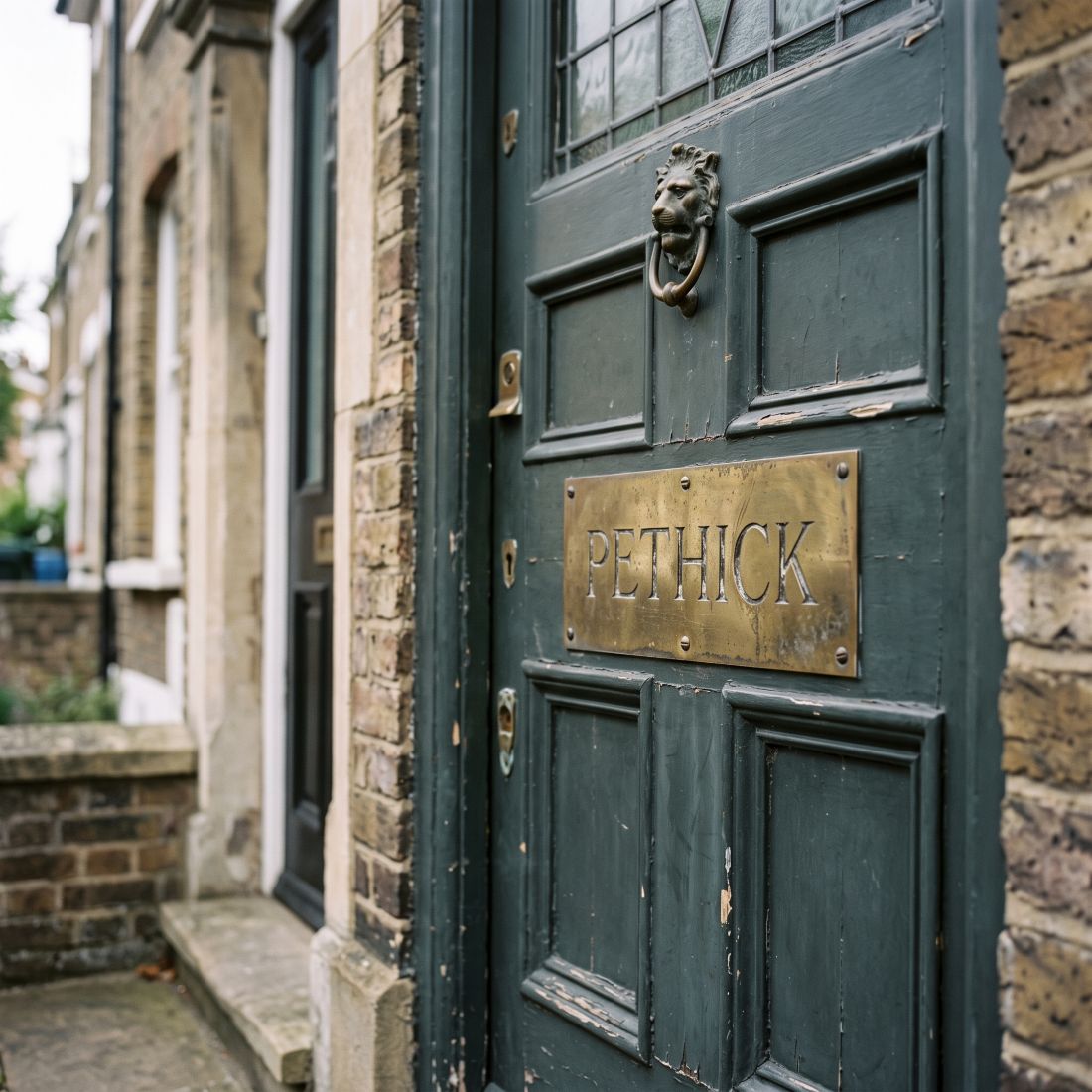
The door on Cleaver Square in Kennington that changed how I talk to clients about brass was a 1790s six-panel, painted near-black, with a lion’s head knocker so packed with dried Brasso that the mane had filled in solid. The owner had polished it every Saturday for eleven years. Eleven years of white paste worked into every undercut, drying there, going grey, building up like limescale in reverse until the casting had lost its detail. I got most of it out with a cocktail stick and a soft toothbrush over about forty minutes. I did not get all of it.
That is the thing about brass on a period front door. The damage almost never comes from neglect.
Is the brass on your front door actually brass?
Start here, because half the advice online assumes solid brass and a good number of London front doors haven’t had solid brass on them since about 1987.
Original Victorian and Georgian door furniture was usually cast – heavy, slightly irregular on the back face, with visible casting seams if you look at the underside of a knocker. Edwardian pieces get lighter and more pressed. Then you have the replacement wave: brass-plated steel and “antique brass effect” zinc alloy sold through the big sheds from the late seventies onwards, fitted to thousands of doors across Greater London when originals were stolen, or lost, or thrown in a skip during a rip-out. Those look convincing until you clean them.
The difference matters because plating is measured in microns. Polish it with an abrasive and you go through to the steel, and once you have gone through, no amount of Autosol brings it back.
What the magnet and the green tell you
Carry a fridge magnet. If it grabs the knocker, there is a steel core and you are looking at plate – clean it with warm soapy water and nothing else, ever. If the magnet drops away, you have a copper alloy, which means brass, or occasionally bronze on some Edwardian doors around Brackenbury Village in W6, where the darker chocolate patina is original and worth keeping.
Green is different information. Verdigris is copper salts, and on a lacquered fitting it means water has got under the coating and is sitting there. Polishing the outside does nothing for that. The lacquer has to come off.
Why does London tarnish brass faster than a Norfolk village?
Sulphur dioxide levels have fallen a long way since the Clean Air Acts, and yet brass in London still goes dull in weeks rather than months. Some of it is particulate – the greasy urban film that settles on everything within a few streets of a red route. I have cleaned identical brass letterplates on Old York Road in Wandsworth and on a quiet cul-de-sac off the top of Hither Green Lane, same age, same alloy, and the Wandsworth one needed doing three times as often.
The rest is us. Skin carries salt and fatty acids, and a brass knob handled forty times a day gets a fresh dose of both every time.
Winter adds the last insult. Grit and rock salt from the front steps gets kicked up onto the lower part of the door, and salt in solution on brass is a fast, ugly business. Doors with a low letterplate suffer for it – nine times out of ten the pitting I find on a letterplate flap sits along the bottom edge, not the top.
Which side of the door does the damage
Look at your own knocker in daylight. The parts your hand touches are usually bright. The recesses are brown. That mottling is why weekly polishing so often looks worse than a door left alone for a year, because you are only ever cleaning the high points and the contrast keeps widening.
What should you use on lacquered fixtures, and what will wreck them?
Most brass door furniture sold in the last thirty years arrives lacquered. Under the coating the metal stays bright; the coating itself is what dulls, scratches and eventually fails.
For lacquered brass the whole method is warm water, a drop of washing-up liquid, a microfibre cloth, and a dry cloth immediately afterwards. That’s it. No Brasso, no Peek, no wadding, no ammonia. Brasso on lacquer hazes it in a single pass, and once hazed the tarnish underneath comes through in patches and you have created a problem that only stripping will fix. Glass cleaner is the sneaky one – overspray from doing the fanlight lands on the door furniture, and the ammonia in it attacks certain lacquers and can stress-crack them at the edges.
Unlacquered brass is the opposite proposition. It wants an abrasive polish, sparingly, on a cloth rather than straight onto the metal, worked with the grain of the original finishing marks. Wear nitrile gloves, and not for the polish – for your own fingerprints, which will etch the surface within about three days of you finishing.
Two other things about polish. Get it out of the screw slots and the beading afterwards – a cocktail stick, a dry toothbrush, then a final buff with a clean cloth folded over your fingertip. And do not polish the escutcheon plate around a rim lock while the polish can run down into the keyway, because it will find the lever pack and stay there.
When to strip the lacquer instead
Once lacquer has gone patchy there is no partial fix. If the piece unscrews, take it off the door and drop it in a bowl of just-boiled water with a couple of tablespoons of soda crystals; most modern lacquers lift within ten minutes and peel off in sheets. Stubborn older coatings need acetone and 0000 grade wire wool, worked outdoors.
Then comes the decision, and here is where I part company with most of the trade: on a Victorian or Georgian London front door, I think unlacquered brass should be allowed to go brown. The mirror-bright, freshly-Brassoed knocker is a twentieth-century taste. A door on Canonbury Square with soft, even, chestnut-coloured door furniture reads as original. The same door with everything blazing gold reads as a refurbishment. Left unlacquered and unpolished, brass reaches a stable dark patina in about eighteen months and then stays there, needing a wipe and nothing more.
How do you clean a letterplate without seizing the spring?
Letterplates are the fitting people ruin, because they have moving parts and everyone treats them like a flat plate.
The sprung flap pivots on a rod running through the frame, with a torsion spring at one or both ends. Polish paste migrates straight into that pivot, dries, mixes with grit and forms a grey paste that binds the spring. Verdigris does the same job more slowly. Once it is bound, the flap either hangs open and lets the hallway freeze or snaps hard enough to take a knuckle off the postman. Royal Mail’s own guidance on aperture height and flap resistance exists for a reason, and a Victorian plate stiffened with dried Brasso fails it comfortably.
Undo the two bolts through the door and take the whole thing off if you can. Fifteen minutes of work, and it means you can clean the back face, the edges of the aperture and the timber underneath – which is where rot starts on a south-facing door, unseen, for years. If it will not come off, mask the paintwork around it with low-tack tape before you go near it with anything.
Lubricate with a dry PTFE spray or one drop of light machine oil on each pivot end, then wipe it dry. WD-40 is not a lubricant for this; it flashes off and leaves a film that collects dust and gums the spring within a season.
The bit behind the door nobody cleans
Inside face of a letterplate collects a startling amount of dust, pollen and post-related grit, and on a house with an internal brush seal or draught flap it collects more. The brush strip is a consumable. When the bristles have splayed and gone limp – four or five years on a busy door – it is a ten-pound part and four screws, and it will do more for your hall temperature than the brass ever will.
When is it better to leave the brass alone?
Painted-over brass on a rental in Walthamstow, five coats of gloss over a Victorian knocker: leave it. Stripping means solvent or heat on paint that, if the house was decorated before 1992, may well contain lead. Wet methods only, test first, and the knocker can wait for the next full redecoration.
Listed buildings and conservation areas add another layer. Cleaning original door furniture is unrestricted. Replacing it on a listed building is alteration, and consent is a separate conversation – one that catches out plenty of owners in the Bedford Park and Crouch End conservation areas who have quietly binned a Victorian knocker for a shiny reproduction.
And if the brass is deeply pitted, stop. Pits are lost metal. Chasing them with abrasive only widens the crater and thins everything around it.
Knowing when to stop, and when not to book us
This is a ten-minute job you can do yourself, and I would rather you did. Adding brass to a regular clean is a bad idea nine times out of ten, because a cleaner working through a four-hour list will reach for the same general-purpose spray they used on the skirting, and that spray will be alkaline. If a cleaning company sells you “brass restoration” as an add-on and cannot tell you on the phone whether they intend to re-lacquer afterwards, they are polishing plate off someone’s grandmother’s knocker somewhere in Greater London this week.
Two cloths, a bowl of warm water, and a magnet in your pocket. Nine times out of ten that is the whole kit.